After turning the high, rusty-red crag, called Bass Harbor
Head, where a squat little lighthouse, in white cassock and black
cap, sits demurely looking off to sea, we see before us... a
large cluster of islands, covering the approaches to a deep indent
of the sea, over which the mountains bend down as if to shut
it out from all intrusion. These are the Cranberry Islands...
and that shut-in water is Somes Sound.
-- Samuel Adams Drake, The Pine Tree Coast,
1891 Bass
Harbor, a picturesque village of the municipality of Tremont, is at the
southwestern tip of Mount Desert Island in an area known to locals as
“the quiet side.” This pretty lighthouse in its rugged setting is
visited by tens of thousands of tourists each year, and it easily ranks
as one of the most-photographed lighthouses in all New England.
|
The
1855 annual report of the Lighthouse Board stated, “There is a very
good harbor about four miles west of Mount Desert Harbor, called Bass
Harbor. A light is necessary to assist vessels entering it.” Congress
soon appropriated a sum of $5,000, and title to the needed land was
secured in 1857. A 32-foot-tall lighthouse was built at rocky Bass
Harbor Head in 1858. The cylindrical brick lighthouse tower is attached
to the one-and-one-half-story, wood-frame keeper’s house by a covered
walkway. |
- From the collection of Edward
Rowe Snow
- Courtesy of Dorothy Bicknell
|

|
A
fixed red light went into service on September 1, 1858. It served to
warn mariners of the Bass Harbor Bar at the eastern entrance to Bass
Harbor, and also to mark the southeast entrance to Blue Hill Bay.
Throughout its history as a staffed light station, Bass Harbor Head was
home to a single keeper and his family.
The first keeper was
John Thurston, at $350 yearly. Thurston lived at the light station with
his wife, Nancy. A baby boy, Charles, was born at the lighthouse to
their son, Solomon Thurston, and his wife, Mary.
According to
family tradition, when Charles was three years old he fell from a
window of the lighthouse. Luckily, he was wearing a long dress, as
small boys often did in that era. Someone managed to catch the dress
and snatch Charles back to safety before he fell to the rocks below.
|
| The
house had four rooms and an attached kitchen. In 1878, the T-shaped
dwelling was raised ten inches and the original board-and-batten siding
was replaced with clapboards. The kitchen was extended in 1900, and an
office was added to the first floor. The station originally had a
hand-rung fog bell. A new 4,000-pound fog bell replaced the earlier one
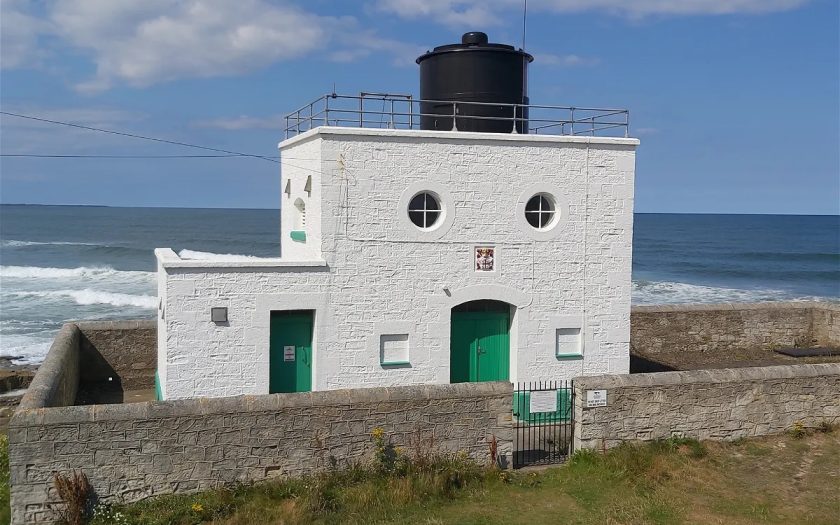
in 1898, its striking machinery housed in a new fog signal building
that still stands. |
- U.S. Coast Guard photo
|
An
1,800-gallon cistern in the dwelling’s cellar collected rainwater for
the use of the keeper’s family. A 1902 brick oil house, 205 feet
northwest of the lighthouse, still remains. There was not originally a
pier at the station, and landing a boat was often difficult. A
boathouse and boat slip were built in 1894, and a boat winch was added
the following year.
The original fifth-order Fresnel lens was
replaced in late 1901 by a fourth-order lens, manufactured in Paris by
Henry-Lepaute. The lens remains in use today. The light is now
automated and shows an occulting red light 56 feet above mean high
water.
Surprisingly,
for a comfortable family light station, not many keepers stayed more
than a few years. The longest stints were by Willis Dolliver
(1894–1912) and Joseph M. Gray (1921–38).
In his 1935 book, Maine Lighthouses and the Men Who Keep Them, Robert Thayer Sterling reported that Gray did “not forget to salute all passing craft.” |
- The 1876 bell tower is behind
the 1898 fog signal building
|

Elmer Reed was keeper at Bass Harbor Head 1938-40, at the end of a long career. Courtesy of the Maine Lighthouse Museum. | According to Edwin Valentine Mitchell’s 1940 book Anchor to Windward,
Bass Harbor Head for a time had a “fog dog” much like the ones at Owls
Head and Wood Island. According to Mitchell, the keeper’s dog would
take the fog bell’s rope in his teeth in attempts to ring the bell in
reply to salutes from the Maine Seacoast Mission’s boat Sunbeam. “It is a big bell,” Mitchell wrote, “but the dog sometimes succeeded in ringing it.”
Eugene Coleman retired as keeper in 1955 after a long career that
included time at Boon Island, Popham Beach, Cape Neddick, and Cape
Cod’s Nauset Light. Coleman’s wife said she liked Bass Harbor Head best
of all the stations, because she had a telephone and was able to drive
to town instead of crossing by water. At Bass Harbor, she was even able
to participate in a garden club. |
The last civilian keeper was Morton M. Dyer, who arrived at the station
in 1955, near the end of a career that included time at White Island
Light, New Hampshire, and the Maine lighthouses at the Cuckolds and
Deer Island Thorofare. Dyer retired at the age of 70 in 1957, and the
station became home to a Coast Guard keeper and his family.
The
light was converted to electric operation in 1949. After automation in
1974, the station was retained as housing for a Coast Guard family.
Several commanders of Coast Guard Group Southwest Harbor have lived in
the keeper’s house.
| The oil house |
 | When Robert Burchell moved in with his family in 2004, he reported that
most tourists at the station were quiet and respectful, but some
occasionally tried to open the door to the keeper’s house. “Our
children should learn some valuable lessons being here,” he said. “We
don’t even have cable TV installed yet.” |
|

|
Bass
Harbor today is a secluded fishing village and the location of a ferry
to Swan’s Island. There is a large parking area near the lighthouse
that often fills up in summer. A path leads down to the granite
boulders neighboring the light station. To get a good view of the
lighthouse it is necessary to climb a distance over the rocks; extreme
caution should be taken.
|
Island
Cruises of
Bass Harbor offers a cruise that affords the chance to see this
lighthouse, one of the most scenic on the New England coast, from the
water.
-
Keepers: John Thurston (1858-1861); John Rick
(1861-1865); John Wilson (1865-1869); Charles B. Gilley (1869-1872);
James L. Wilson (1872-1880); C. F. Chase (1880-1890); William
T. Holbrook (1890-1894); Willis Dolliver (1894-1912); Joseph
M. Gray (1921-1938); Elmer Reed (1938-1940); Leverett Stanley
(1940-1950); Eugene L. Coleman (1950-1955); Morton M. Dyer
(1955-1957)
|