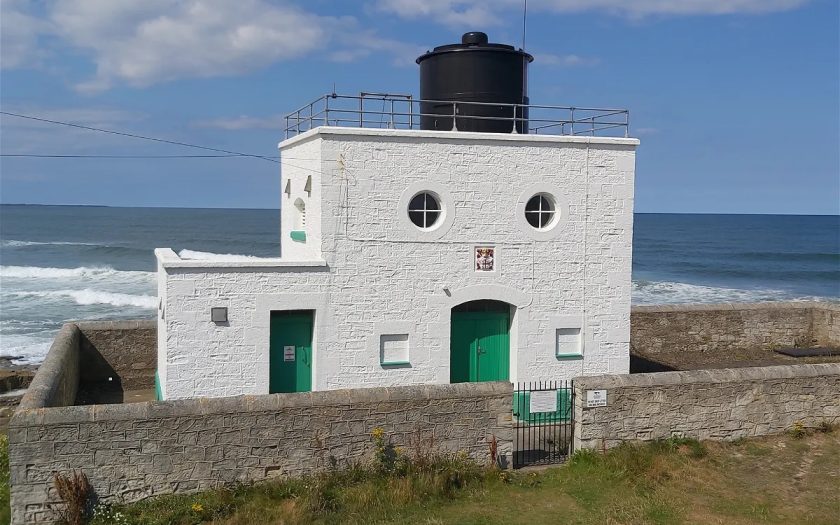
|
Stark little Bird Island—less than two acres—is just a few hundred yards off Butler’s Point near the entrance to Marion's Sippican Harbor, on the west side of Buzzards Bay. The name “Sippican,” the local Indians’ word for “the long river” or “land of many waters,” according to different sources, once applied to a wide area.
A severe storm struck the area at the end of December 1819, devastating the new light station. Moore, who lost his boat and a large supply of wood, described the damage in a letter to Dearborn:
Letters
from Moore to Dearborn indicate that the keeper conducted experiments
with the heating of whale oil to keep it from freezing in the winter
months. He also worked on the development of “air boxes” to be stored
on boats to help prevent sinking. Moore told Dearborn that he
wanted to remain at Bird Island so he could pursue his various
experiments. He explained, “. . . as the keeping of a lighthouse is
calculated to afford me more leisure than almost any other employment,
I shall give it up with great regret.” Persistent local legend claims that Moore was a pirate who was banished to Bird Island as punishment. Some versions of the story claim—preposterously—that he was left without a boat, with supplies delivered periodically. Since his boat is mentioned frequently in correspondence, this is clearly untrue. In any case, properly functioning lighthouses were vital to safe navigation, and the authorities strove to hire responsible and reliable men, not accused pirates. Some accounts claim that Moore murdered his wife—described as a “Boston society girl”—at the lighthouse and disappeared soon after. A rifle was purportedly found in a secret hiding place, along with a bag of tobacco, when the original keeper's house was torn down in 1889. The gun was believed by some to be the murder weapon. Others have claimed that Moore prevented his ailing wife from seeking medical attention on the mainland, and that she died as a result. Although she is supposedly buried on the
island, there is no sign of the grave of Moore’s wife today. With the
gun, a note was found, signed by Moore. The note eventually came into
the possession of Marion’s longtime town historian H. Edmund
Tripp. It read: This
bag contains tobacco, found among the clothes of my wife after her
decease. It was furnished by certain individuals in and about
Sippican. May the curses of the High Heaven rest upon the heads of
those who destroyed the peace of my family and the health and happiness
of a wife whom I Dearly Loved. Another far-fetched part of the lore surrounding William Moore is that he disappeared, never to be seen again, shortly after his wife’s death was discovered. In reality, records clearly show that Moore was assigned to the new Billingsgate Lighthouse near Wellfleet in 1822. It isn’t clear if he was able to continue his experiments there. The truth about Moore will probably never be completely separated from the fantastic legends concerning his life. But his wife did die on the island, and there are those who say it has been haunted or cursed ever since. According to a newspaper article in the Standard Times, legend has it that some later keepers were frightened by the “ghost of a hunched-over old woman, rapping at the door during the night.”
Carpender recommended that it be changed from a flashing white light to a fixed red light, and that the number of lamps be reduced from ten to six. This would, said Carpender, save taxpayers $143.50 yearly. The recommendations went unheeded. Engineer I. W. P. Lewis visited Bird Island during his survey of 1842, and Clark provided him with this gloomy statement: I was appointed keeper of this light in 1834, upon a salary of $400. . . The tower is in a bad state, very leaky, and wood work all more or less rotted. The lantern . . . is crowded exceedingly, and leaks badly at all the angles; the glass is continually broken by the rust; the lantern sweats very much, and makes ice upon the glass in winter half an inch thick. The whole light-house is in a bad state, and I think was not built in a faithful and workmanlike manner. Clark also
complained that he had to bring his drinking water from the mainland,
as there was no source of fresh water on the island. An
authorization of $1,000 in 1843 paid for a new 600-foot stone seawall,
a 25-foot extension to the wharf, the construction of a cistern for the
water supply, the reshingling of the dwelling roof, and the painting of
the buildings. In November 1866, during Marshall V. Simmons’s stint as keeper (1861-69), a severe storm swept the island, flooding the cellar and the well, damaging the seawall and carrying away part of the enclosure fence. Repairs were swiftly completed. Simmons was still the keeper on September 8, 1869, when a storm of “unprecedented severity” caused widespread destruction in New England. The seas covered Bird Island completely during the height of the storm, demolishing 280 feet of sea wall. The waves also destroyed a barn and carried away other outbuildings and fences. The official report stated that the lighthouse station was reduced “from a condition of perfect order to a perfect wreck.”
The 1889 annual report contained the following misleading entry on Bird Island: “Measures are in progress for rebuilding the dwelling and tower surmounting it.” The house was clearly rebuilt at this time, but the tower at Bird Island had never surmounted the dwelling. This statement by the Lighthouse Board seems to account for the common assertion that the tower was rebuilt in 1889. There were a number of so-called “Cape Cod” style lighthouses with towers mounted on top of the keeper's dwellings in the nineteenth century, and someone may have confused Bird Island Lighthouse with another. The present tower clearly survives from 1819. The station had an assistant keeper for a few years in the 1860s and 1870s. Charles A. Clark filled that role for a brief period before he became the principal keeper in 1872, and he would remain in charge until 1891. Clark’s brother was once cleaning a gun on the island—presumably for the hunting of waterfowl—when he accidentally shot himself. He was quickly transported by boat to a doctor in Marion and narrowly escaped death. Peter Murray became keeper in 1891. In 1980, Murray's daughter, 91-year-old Frances Murray Rathbeg, recalled the family's life on the island, which she called a "sad place." The harsh winters, said Rathbeg, were especially difficult. During one winter, Keeper Murray's 11-month-old son, Gerald, became ill with pneumonia. "We had no way to get off the island," Rathbeg saidrecalled. "The baby coughed and screamed." With no other way to signal for help, the desperate keeper extinguished the light to attract attention. Help eventually arrived, but too late; the baby had died. The Murrays buried their child on the mainland and never returned to Bird Island.
In 1994, a new effort was mounted when the Bird Island Preservation Society was formed by Charles J. Bradley, a local shellfish officer. In 1996, the societyhired International Chimney Corp. of Buffalo, New York, to do restoration work. The company had gained fame in lighthouse circles after their successful moves of Block Island Southeast Light in Rhode Island, and Highland and Nauset lights in Massachusetts. Jim Scott, a foreman for International Chimney, noted that the lighthouse was very solidly built and would be around for a long time to come. The International Chimney crew arrived on the island in October 1996 and began with the sandblasting and repointing of the exterior. After completing much of the project that fall, the workers returned in the following spring to finish the job.
In February 2008, Charles Bradley stepped down as chairman of the Bird Island Lighthouse Preservation Society. Hopefully, others will step in to carry the torch. "You've got to have a little love for the project," said Bradley. "You need the enthusiasm." Custody of Bird Island was transferred to the Marion Marine Department in 1998. The nesting population of roseate terns—an endangered species—on the island is around 1,500 pairs. It’s the largest breeding colony of the species in North America. In fact, it comprises about half of the known breeding population on the continent. Bird Island Light can be seen distantly from shore but is best viewed by private boat. For more information or to help with the ongoing preservation of Bird Island Light, contact:
Keepers (This
list is a work in progress. If you have any information on the keepers
of this lighthouse, I'd love to hear from you. You can email me at
nelights@gmail.com. Anyone copying this list onto another web site does
so at their own risk, as the list is always subject to updates and
corrections.): William S. Moore (1819-1834); John Clark (1834-1849 and 1853-1861); James Delano (1849-1853); Marshall V. Simmons (1861-1867); W. A. Simmons (assistant, 1867-1868; principal keeper 1869-1872); A. B. Bowman (assistant, 1868-1869); Russell G. Gray (assistant 1870-1871); Charles A. Clark (assistant 1871-1872; principal keeper 1872-1891); Jabez Jenney (assistant, 1872); Peter Murray (1891-1895); Zimri Tobias ("Toby") Robinson (1895-1912); C. W. Jordan (1912); Elliott Hadley, Jr. (1912-1917); H. H. Davis (1917-1919); Maurice A. Babcock (1919-1926); George T. Gustavus (1926-1933). |