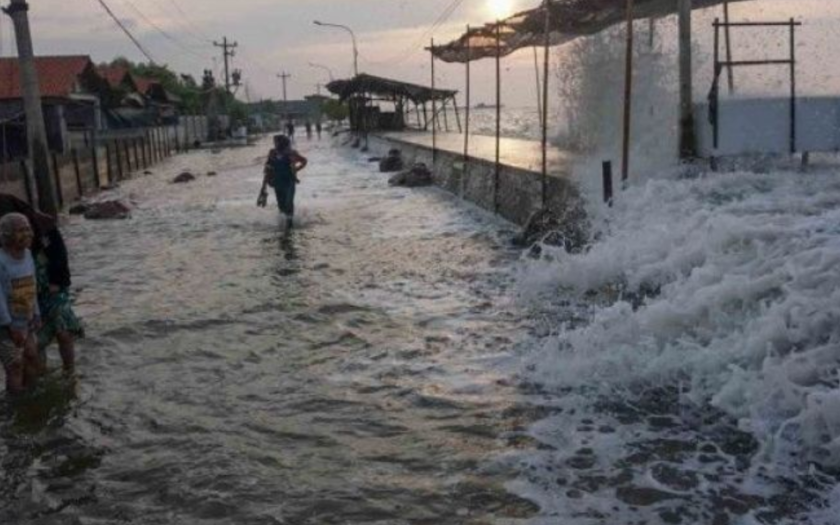
There is neither tree nor shrub, and hardly a blade of
grass on the rock. The surface is rough and irregular and resembles
a confused pile of loose stone. Portions of the rock are frequently
swept over by waves which move the huge boulders into new positions.
-- 1891 Annual Report of the Lighthouse Board.
|
Matinicus Rock is a windswept
32-acre granite island, 18 miles off the mainland and 25 miles
from Rockland, the nearest port. "The Rock" is five
miles south of the much larger Matinicus Island. It was recorded
by Capt. John Smith in 1614, who made notes in his log about
"the rock of Mattinack."
Because of its prominent location on the approach to busy
Penobscot Bay, Congress and President John Quincy Adams authorized
the building of two lighthouses on Matinicus Rock in 1827. It
was considered a primary seacoast light station.
|
- U.S. Coast Guard photo
|
- Matinicus Rock c. 1870s
|
The first lighthouse building was a stone dwelling with a
wooden tower at each end, 40 feet apart. Each tower exhibited
a fixed white light. The first keeper, 65-year-old John A. Shaw,
was appointed at a yearly salary of $450. Shaw and his wife lived
at the station until 1831, when Shaw became too ill to continue
as keeper. He subsequently died in a Portland hospital. The second
keeper, Phineas Spear, also died after a short time at the Rock.
The cold, damp air and frequent storms no doubt contributed to
the keepers' illnesses.
A tremendous storm in January 1839 did much damage to the
buildings and put the lights out of operation. Two days later,
the keeper was able to hang a temporary lamp from a mast. The
station was soon repaired. Two months after the great storm,
Samuel Abbott was appointed keeper at $450 yearly.
|
In February 1842, Abbott and his family were forced to take
refuge in the attic of the dwelling during another storm that
produced unusually high seas. The kitchen wing of the house was
practically demolished by the waves and the first floor was filled
waist-deep with water. "Had not a sudden shift of wind ensued,"
Abbott reported, "I believe another shock would have entirely
destroyed the building."
|
A new granite dwelling was built in 1846. Two years later,
new granite lighthouse towers were erected 60 yards apart. The
old wooden towers were torn down, but the first dwelling remained
and was used as a storage shed.
Because Matinicus Rock was frequently enshrouded in fog, a
2,000-pound fog bell was added in 1856. The bell is now at the
Maine Lighthouse Museum in Rockland, Maine. A new bell tower
with striking machinery was installed in 1867. In 1869, a steam-driven
fog whistle -- one of the first used anywhere -- was installed.
The bell was retained as a backup signal.
|
Fog bell at Matinicus Rock, date unknown.
From Matinicus Isle: Its Story and its People, by Charles
A. E. Long, 1926.
|
Samuel Burgess became keeper in 1853. Burgess and his invalid
wife, Thankful (Phinney) moved to the station with several of
their ten children; their oldest daughters had already married.
Their oldest son, Benjamin, soon left to earn a living as a fisherman.
The Burgess's oldest daughter living at the light station, Abbie,
had been born on Matinicus Island in August 1839. She quickly
learned to light the whale oil lamps and perform other duties
around the Rock.
In January 1856, Burgess left in his sailboat to pick up supplies
in Rockland, leaving Abbie alone with her mother and younger
sisters. "I can depend on you, Abbie," he said as he
left the island.
By the afternoon a storm began to approach Penobscot Bay.
Soon the waves grew large as the wind increased, and the gale
continued to worsen over the next three days. On January 19,
Matinicus Rock was practically underwater. Abbie moved her mother
and sisters to the north lighthouse tower. She later wrote:
The new dwelling was flooded and the windows had to be
secured to prevent the violence of the spray from breaking them
in. As the tide came, the sea rose higher and higher, till the
only endurable places were the light-towers. If they stood we
were saved, otherwise our fate was only too certain. But for
some reason, I know not why, I had no misgivings, and went on
with my work as usual. For four weeks, owing to rough weather,
no landing could be effected on the Rock. During this time we
were without the assistance of any male member of our family.
Though at times greatly exhausted with my labors, not once did
the lights fail. Under God I was able to perform all my accustomed
duties as well as my father's.
|
Abbie waded knee-deep in the water to rescue her pet chickens
from their coop. A short time later a gigantic wave swept the
island and destroyed the original keeper's house. The rough seas
abated somewhat, but it remained impossible to land at the Rock
for four weeks. During this time Abbie kept the lights burning
and cared for her mother and sisters.
Samuel Burgess finally made it back to the Rock, happy to
find his family alive and well. Again in 1857 he was away for
three weeks during a stormy period. This time the family's food
supply was reduced to one egg and a cup of corn meal mush a day
before supplies arrived.
Samuel Burgess lost his job in 1861 for political reasons.
Capt. John Grant, a friend of the Burgess family, became the
next keeper. Abbie stayed on to help train Grant. The new keeper's
son, Isaac, was the assistant keeper.
A romance quickly developed between Abbie Burgess and Isaac
Grant, and they were married within a year. Abbie was officially
appointed assistant keeper at $440 per year. The couple had four
children at the Rock before Isaac Grant's appointment to Whitehead
Light in 1875.
|
 |
A child buried on Matinicus Rock in 1881, Bessie Grant, was
long believed to be the daughter of Abbie and Isaac, but was
in fact the daugher of Isaac's brother, John Francis Grant, and
his wife, Samantha.
Isaac's father, John Grant, remained principal keeper for
nearly 30 years, except for the 1867-71 period, when he served
as an assistant under Christopher Chase. The book All Among
the Lighthouses by Mary Bradford Crowninshield described
a visit to Matinicus Rock in 1886, when John Grant was keeper:
This venerable man has been the keeper at Matinicus for
many years, and he and his sons have been most faithful and invaluable
assistants to the Lighthouse Service. At no station are the lights
kept in better order, or the dwellings neater or more prepossessing
in appearance, than at this place.
In 1891, Abbie Burgess wrote at Whitehead Light :
Sometimes I think the time is not far distant when I shall
climb these lighthouse stairs no more. It has almost seemed to
me that the light was part of myself. ...Many nights I have watched
the lights my part of the night, and then could not sleep the
rest of the night, thinking nervously what might happen should
the lights fail.
I wonder if the care of the lighthouse will follow my soul
after it has left this worn out body! If I ever have a gravestone,
I would like it in the form of a lighthouse or beacon.
|
Abbie Burgess Grant died in 1892 at the age of 53. In 1945,
historian Edward Rowe Snow organized a gathering at her grave
in a tiny Spruce Head cemetery. A little metal lighthouse was
unveiled at the foot of Abbie's grave.
Abbie had her wish at last. Poet Wilbert Snow read a poem
that called Abbie "the friend and guide of sailors through
dark nights." The lighthouse on Abbie's grave was refurbished
in 1995 by the American
Lighthouse Foundation.
|
 |
A new pair of granite lighthouse towers, 180 feet apart, had
been built on the Rock in 1857. The lanterns held third-order
Fresnel lenses. The same year a second story was added to the
keeper's house.
- From "Stebbins Illustrated Coast
Pilot," 1902
|
The north light was extinguished on July 1, 1883,
and the light in the south tower was changed from fixed white
to fixed red. There were many complaints, and the north light
was reactivated on July 1,1888. Both lights were changed back
to fixed white. |
Arthur J. Beal served as an assistant keeper at Matinicus
Rock light from 1919 to 1929. His grandson Dave Gamage wrote
the following:
When he first went there as third assistant, both lights
were in operation. During his service at the Rock, one light
was discontinued and the steam fog whistle was replaced by a
compressed air horn. The third assistant keeper position was
then eliminated. When he left the Rock my grandfather was first
assistant.
My mother lived on the Rock from age four until she entered
high school on the mainland. Like Abbie Burgess, my mother also
raised chickens. Life on the Rock was somtimes very difficult,
and there were long periods of time when one could not get on
or off because of storm seas making safe landing impossible.
The closest store and post office was on Matinicus Island about
five miles distant, but it might just as well have been 1000
miles if one could not get there.
The light station did have phone contact with Matinicus
and the mainland except during extended outages when the underwater
phone line was damaged. Much of their entertainment came from
all the keepers' families gathering around and listening to an
AM radio in the evening or playing 78 rpm records on a hand-wound
Victrola. Of necessity, the younger children on the station were
home schooled.
|

|
The north light, which was discontinued for a few years in
the 1880s, was darkened for good on August 15, 1923. Around this
time, the government decided to change all twin light stations
to single lights. Recent
research by Terry Pepper of the Great Lakes Lighthouse Keepers
Association has revealed that the lantern from the north tower at
Matinicus Rock, after some time in storage, was installed atop the 1929
lighthouse at Poe Reef, off Bois Blanc Island, Michigan.
The third-order Fresnel lens at left, installed in the south
light in 1923, is now on display at the Maine Lighthouse Museum
in Rockland (left).
|
Another storm swept Matinicus Rock in 1933, washing through
the house and leaving debris waist-deep. After another storm
in 1950, the Coast Guard removed most of the outbuildings. Today
only the keeper's house, an 1890 oil house (an earlier oil house
was swept away in an 1888 storm), and the two towers remain.
The bases of the 1848 towers are still visible.

This photo from about 1926 shows, left to right, Second Assistant
Keeper Austin Beal, First Assistant Keeper Arthur J. Beal, and
Keeper Frank O. Hilt. Keeper Hilt was described as a "300-pound
genial giant." From Matinicus Isle: Its Story and its
People, by Charles A. E. Long, 1926.
-
| David Brackett of New Hampshire, a former Coast
Guard keeper at Matinicus Rock Light, described life there to
Natalie Peterson for the Granite State News. Brackett
spent 14 months at "The Rock" while his wife lived
in Camden. "Our station was immaculate. We used bowling
alley wax on the hardwood floors and never wore our shoes inside,"
remembered Brackett. Brackett and his three crew mates rebuilt
the old tramway, used to bring supplies up to the light station.
They also did a great deal of maintenance on the buildings. Winters
were rough; one storm during Brackett's tenure brought 84 mph
winds and waves right over the lighthouse tower. The fog signal
had an unexpected effect on Brackett. When he returned to shore,
his wife wondered why he was speaking for 20 seconds at a time,
then pausing. It was because he had unconsciously adjusted to
the fog signal's deafening blast each 20 seconds. |
- U.S. Coast Guard photo
|
In 1983, the south light was automated and the Fresnel lens
was replaced by a plastic lens. The Coast Guard keepers, who
sometimes called Matinicus Rock "Alcatraz," were removed.
A heliport had been installed on the Rock to move keepers on
and off.
The remaining flashing white light is still an active aid
to navigation. Under the Maine Lights Program, the lighthouse
became the property of the U.S. Fish and Wildlife Service in
1998. The National Audubon Society researches and protects the
island's seabird population. The Rock is home to a nesting colony
of puffins, as well as terns and other seabirds.
Keepers: John A. Shaw (1827-1831, died in service);
Phineas Spear (1831-1834, died in service); Abner Knowles (c.
1836); Thomas McKellar (c. 1838); Samuel Abbott (1839-184?);
William Young (184?-1853); Samuel Burgess (1853-1861); Benjamin
Burgess (assistant, 1856-1861); John H. Grant (principal keeper1861-1867
and 1871-1890; assistant 1867-1891), Christopher Chase (1867-1871);
William G. Grant, first assistant keeper, then keeper (1875-1900);
Isaac Grant (first assistant keeper, 1861-1875); Abbie Burgess
Grant (second assistant keeper, 1861-1875); John F. Grant, second
assistant keeper (1876-1887); Knott C. Perry, third assistant
keeper (1877-1881); Jacob T. Abbott, third assistant keeper (1881-1886);
Jarvis H. Grant, second assistant keeper (1887-1888); William
F. Stanley, second assistant keeper (1888-1891); Thad Wallace,
third assistant keeper (1888-1891); Aldiverd Norton, third assistant
keeper (1890-1897); Llewell[yn?] Norwood, third assistant keeper
(1891-1895), Fred Hodgkins, third assistant keeper (1892), George
A. Lewis, third assistant keeper (1892-1898); James E. Hall,
third assistant keeper, later first assistant, then keeper (1896-1908);
Merton Tolman, third assistant keeper, later keeper (1900-1911);
Charles Burgess, third assistant keeper, later second assistant,
then first assistant (1897-19??); Elmer Holbrook, third assistant
keeper, later second assistant keeper (1898-1908); Charles Dyer,
third assistant keeper, later second assistant, then first assistant,
then keeper (1905-1916); Harold Hutchins, third assistant keeper,
later second assistant, then first assistant (1909-1912); Arthur
Mitchell, third assistant keeper, then second assistant, then
keeper (1912-1919); George Studley, third assistant keeper (1912);
J. H. Upton, second assistant keeper (1912); James Anderson (assistant,
1915-1917); Arthur J. Beal (second assistant, then first assistant
1919-1929); V. H. Fernald (c. 1923); Frank O. Hilt (assistant
1913-1919, principal keeper 1919-1929); ? Stinson (assistant,
1919-1926); Alvah Robinson (assistant c. 1930-1935, principal
keeper 1935-1936); R. W. Powers (c. 1933); Roscoe Fletcher (1936-1945);
Joseph Donahue (Coast Guard, c. 1953); Shannon Balke (Coast Guard,
1953); Tom Maddock (Coast Guard, c. 1953); Stanley Hiller (Coast
Guard officer in charge c. 1953-?); Richard Moore (Coast Guard,
c. 1953); Sheldon Kaminsky (Coast Guard, c. 1967-1968); Richard
D. Seibel (1976-1977); John Burlingham (1976-1977); David Brackett
(Coast Guard, c. 1970s); Lee Davis (Coast Guard, c. 1980s); Donald
Lecours (Coast Guard, ?-1983); Larry Crete (Coast Guard, 1980-1983)
|