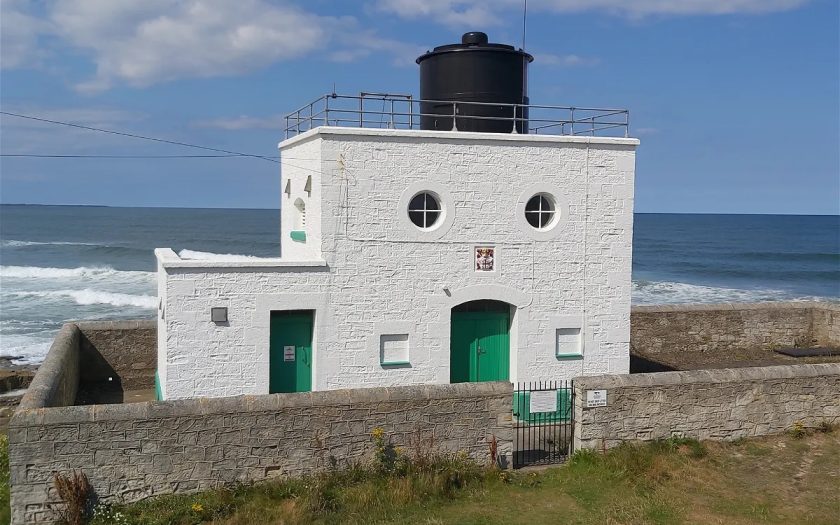
The Narraguagus Light Station, established in April 1853, originally consisted of a tower and lantern in atop the center of a keeper’s dwelling. The first keeper was Joseph Brown. A fifth-order Fresnel lens replaced the original system of multiple lamps and reflectors in 1856. The focal plane of the light was 54 feet above mean high water.
Access to the station was
difficult, requiring a half-mile walk across the island. A boat
slip built near the lighthouse in 1900 was for emergency
access to the island only and was not used by the keepers.
Few of the station's keepers stayed more than a few years until William
C. Gott, who arrived in 1893 and stayed until at least 1915. An inn and clubhouse was were built on the island in 1878, and the three-story Pond Island House continues to operate today. A golf course was added to the island in the 1920s. According to Anne C. Nash’s book Pond Island Heritage, visiting the lighthouse keeper and his family was a typical summer activity for guests at the Pond Island House, when they weren’t busy playing golf or croquet, or competing in wheelbarrow races. According to Nash, Elizabeth Hitchcock, an island resident, recalled girlhood visits with the Gott family at the lighthouse. “I would go to see the keeper’s tall, slender, red-haired wife,” she recalled. “She seemed always to be baking biscuits or yeast bread, and the kitchen smelled of bread, kerosene, and fresh paint.”
In 1886, Lucy Brown Reynolds described a visit to the light station during Gott's stay in her book Drops of Spray from Southern Seas: It was a dark, stormy night, and the keeper's cottage was very cheerful, with its glow of lamp and firelight. A capital supper having been partaken of, we were shown over the lighthouse by the keeper's wife, a cheery, bustling little woman, who seemed delighted to have us there. I had never been inside a lighthouse tower before, and was very much interested in all I saw. The brilliant light sent its warning far out over the troubled waters, bidding all mariners beware. At intervals we could hear the boom, boom, of the steam foghorn at Petit Manan, three miles or thereabouts outside. On August 4, 1929, a Nova Scotia schooner, en route to Salem and Boston, Massachusetts, was wrecked on Petit Manan Bar in a gusty rainstorm. The two keepers at Petit Manan Light Station attempted to aid the crew, but they found that the vessel had already been abandoned. The
captain and three crewmen escaped in the schooner’s rowboat and took
refuge at the Narraguagus Light Station, where the keeper, Charles E.
Tracy, cared them for them for 12 days. On August 16 they left in the
rowboat for a 95-mile journey to Nova Scotia, with food provided by
Tracy. The British consul general at Boston wrote a letter expressing
his thanks for the services of Tracy and the two keepers at Petit Manan
Light.
Narraguagus Light was discontinued in 1934 and the lighthouse
and other buildings and the surrounding five acres were sold
at auction. The lighthouse and keeper's dwelling remain, as well
as the oil house and two storage buildings, still owned privately.
The lighthouse is best viewed by boat. Keepers:
Joseph Brown (1853-1855), Wyman Collins (1855-1859), Daniel Chipman (1859-1861), Alfred Wallace (1862-1865), Joseph W. Brown (1865-1869); George L. Upton (1869-1876), Solomon G. Kelliher (1876-1880), Ambrose Wallace (1880-1882), Warren A. Murch (1882-1885), James M. Gates (1885-1893), William C. Gott (1893-c. 1915), Lester Leighton (c. 1919-?), ? Robinson (?), Charles E. Tracy (c. 1929) |
Last updated 1/11/11